esra günlü kılıç
UX strategy • usability engineering • systems thinking

Space Camp - service design idea
Sector
Project:
Duration
Service design
Service Design Jam 2019
3 days
Role
Scope
Service designer
As a team of four, we designed an appealing service design concept inspired by the term "Blue." The activities we conducted included research, ideation, exploration through creative thinking methods (Crazy 8s, associative thinking, analogies, card sets), visual mapping, persona development, idea validation, storyboarding, paper prototyping, and presentation.


In 2019, I attended the Global Service Jam event organised by Service Design Network in Cologne. This event is an international, three-day workshop that takes place simultaneously in 100 cities around the world. It is the world's biggest design-focused innovation event. This event was one of the turning points in my career as a designer, as it introduced me to service design thinking and methodology in a condensed, learn-by-practice format. I already knew about service design as a discipline, but this experience helped me genuinely understand it, and how it can be utilized in any design discipline to bring a more holistic, service-based perspective into design.
A Service Jam is a cooperative gathering of people interested in a design-based approach to creativity and problem-solving, and, of course, in service design itself. Its aim is to encourage experimentation and innovation. Participants come together without a pre-formed team and without a predefined idea, and are given a theme on the spot to generate ideas around, working in teams. After the concept generation phase, they refine, prototype, and test their ideas with real people, then present their designs and share them with the world through a central platform.
First Day
In the first day , the topic was given and it was; "blue". Turning this very general concept into an design idea necessitated several idea generation and brain storming tools. We started with Metaphor Wheel, where we explored possible metaphorical concepts in different levels of the wheel in a complete free manner. After that we tried to define some Challenges that are related to the metaphors that we defined. Through Brain Walking methods everyone added, questioned and tried to explore each groups metaphors and found challenges. We grouped and organized these challenges in terms of their thematic relations through Affinity Diagrams. Next step was to turn them into How Might We? questions. Through discussions each group voted for found HMW? questions and has chosen one that would be the main challenge that each group would seek for a solution. Each participant has chosen personally among these HMW? challenges according to their interests. Now new and final groups were defined around each different HMW? question. My groups first predefined HMW question was "How might we foster the space tourism?", which was one of my suggestions during our early attempts to define challenges. This question became so popular among participants that we end up with building two groups working around the same HMW question.
HMW? sessions


Second Day
On the second day, following a lecture on service design, its methods, and innovative idea generation techniques, we held brainstorming sessions and discussed our possible user profiles, their needs, contexts, and related scenarios. These early discussions represented our assumptions, which we visualized in an assumption canvas. The next step was to challenge these assumptions through user research. Our main assumption was that children would be highly interested in going to space and experiencing related activities, since we believed that almost every child dreams of being an astronaut.
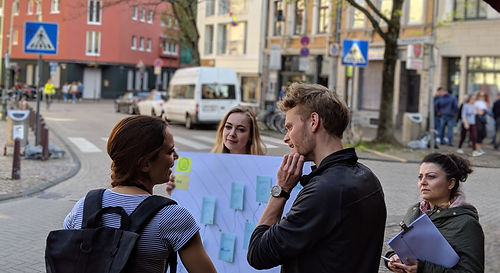
We stepped outside and conducted interviews with children and their parents. Interestingly, they didn't seem particularly interested in such an experience. Neither the children nor the parents gave especially positive responses. Both groups, but particularly the parents, were concerned about safety. Additionally, they mentioned that they would prefer other, more enjoyable activities. This was a valuable lesson in the importance of questioning and validating assumptions.
User research for validation


We also conducted desk research online and identified a different user group than the one we had imagined at the beginning. We found that there are numerous groups all around the world interested in space travel, mostly made up of people drawn to astronomy, science, and science fiction. These groups organize conferences and meetings, and work to draw public attention to space travel and related activities, aiming to convince governments to fund such efforts and businesses to invest in the topic. Through this, we discovered that there is already significant demand for space tourism. We also found that a number of space tourists already exist, and that there are companies offering this experience for considerable sums of money.
In the end, through desk research, we defined the main characteristics of our persona: someone deeply interested in astronomy, technology, science, and science fiction, but not wealthy enough to afford such an experience.
Reframing problem with design thinking canvas


After reframing our design problem, we began to seek solutions. We used a number of different ideation methods, including Crazy 8s, associative thinking, analogies, and card sets. In the end, we gathered and grouped all our different ideas, hanging our sketches on the wall to discuss them together and decide on our final solution.
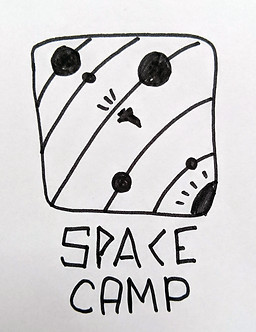
We arrived at the idea of offering a space travel experience through a center based on Earth, building on an initial idea that I had proposed. In our scenario, this center was located in a desert-like area resembling the moon's surface, offering, for example, a three-month space camp. There, people would be trained as if they were astronauts and would experience space travel conditions through technologies simulating real space environments. We considered the training itself to be a key part of the overall experience. We also decided to emphasize that this solution would be more sustainable than an actual space journey.
Ideation for solution


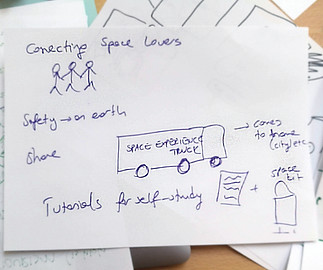


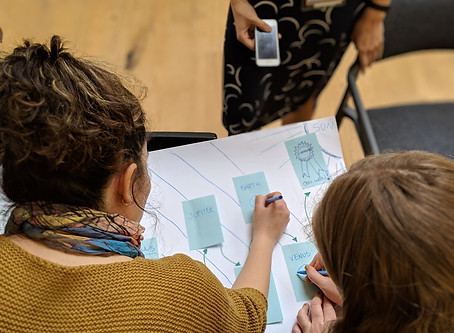
In the final stage, we decided to build a prototype that would be part of our scenario and help us test our idea as a value proposition. We envisioned a game, one that would exist online in a real-world version, designed to challenge users' knowledge of space and astronomy in a fun way. Depending on the participant's performance, the game could result in an invitation to the camp and corresponding cost reductions.
We created a simple paper version of this game and went out into the streets to test both our idea and the game with real people. As it happened, one of our test users turned out to be an astronomy enthusiast. She played the game and gave very positive feedback, both on the game itself and on the overall idea.
Testing the idea


Third day
The third day was mainly devoted to presenting our ideas and solutions in groups, as well as preparing an online presentation to share with jammers around the world. We prepared a short scenario video, which was very well received by other participants at the event, both in terms of the result and the presentation itself.
Use scenario