esra günlü kılıç
UX strategy • usability engineering • systems thinking
EV charger application
Sector
Project:
Duration
Automotive, Consumer Electronics
Mobile app for EV chargers of Vestel
5+ months
Role
Scope
UX Designer
I designed an application to control the Vestel Electric Vehicle Charger and provide additional functionalities within an IoT system. The process included research, ideation, information architecture, user flow, layout design, prototyping, and the preparation of guidelines for UI and development.
The EV Charger app was one of the first UX design projects of my career, and it holds particular importance for me, as it was where I first experienced how a UX design process unfolds end-to-end. Learning largely by doing, I was nonetheless able to deliver a user-centered design by applying UX tools and methods from the very beginning. I also gained valuable insight into an important topic within the automotive industry.
The project gave me a unique, early opportunity to combine my background in hardware products and physical interactions with my newer area of exploration: digital UX design.
Strategy
Vestel's chargers are designed for both home and public use. The application was intended to target mainly home use, while also considering public contexts. The target user group was broad: EV users in general.
+
@home


Users would be able to control the charging process easily from anywhere.
@work
@public



The first step of the project was to understand the functionality of the EV charger, along with the possible user scenarios and contexts in which it would be used together with the application.
I identified three main use cases within the overall use scenario of this system. As is common for IoT products, the first step was the setup of the charger, consisting of connecting the product to the home Wi-Fi network and creating a user profile. The second was the operation of charging the electric vehicle, which involved a number of different scenarios, such as configuring the charging process or selecting the eco-time slot for the region. The last main use case was retrieving information about the charging status, either instantaneously or as a general overview of usage, which required a dedicated data visualization design. The overall design strategy was built around these three considerations.
Information Architecture
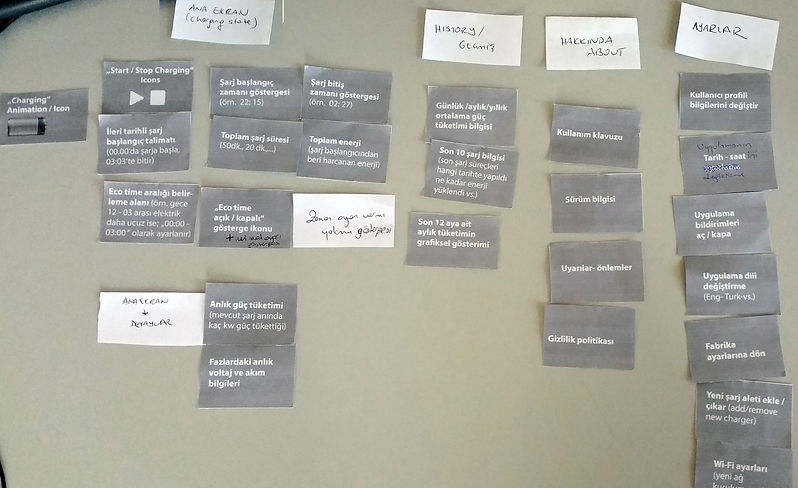
Following the user requirements, I defined the possible functionalities needed to satisfy them. I then focused on defining the information architecture and a corresponding layout. I conducted open and hybrid card sorting sessions, followed by tree testing, through which I formed the application's sitemap.


Final site map with cards
Early Explorations
While working to map out the information architecture, I explored possible layouts and flows through sketches and diagrams.

Prototyping
I prepared low-fi prototypes and wireframes to define the user flows and main interactions. I held discussions around these interactive prototypes and conducted a number of guerrilla testing sessions to validate my decisions.


Lo-fi prototype used for early usability tests and for communication among teams

UI Design
I didn't work as a UI designer on this project; however, I guided the early UI design process to ensure that UX concerns were properly addressed. Unfortunately, I left Vestel early in the UI process, shortly after the main interactions and basic usability concerns had been defined. You can find some examples of the early UI screens of the EV Charger application below.
Drive green app in stores today


I didn't work as a UI designer on this project; however, I guided the early UI design process to ensure that UX concerns were properly addressed. Unfortunately, I left Vestel early in the UI process, shortly after the main interactions and basic usability concerns had been defined. You can find some examples of the early UI screens of the EV Charger application below.